September 22, 2026
How Meta and Google's Ad Tools Power Russia's Predatory Recruitment in Africa
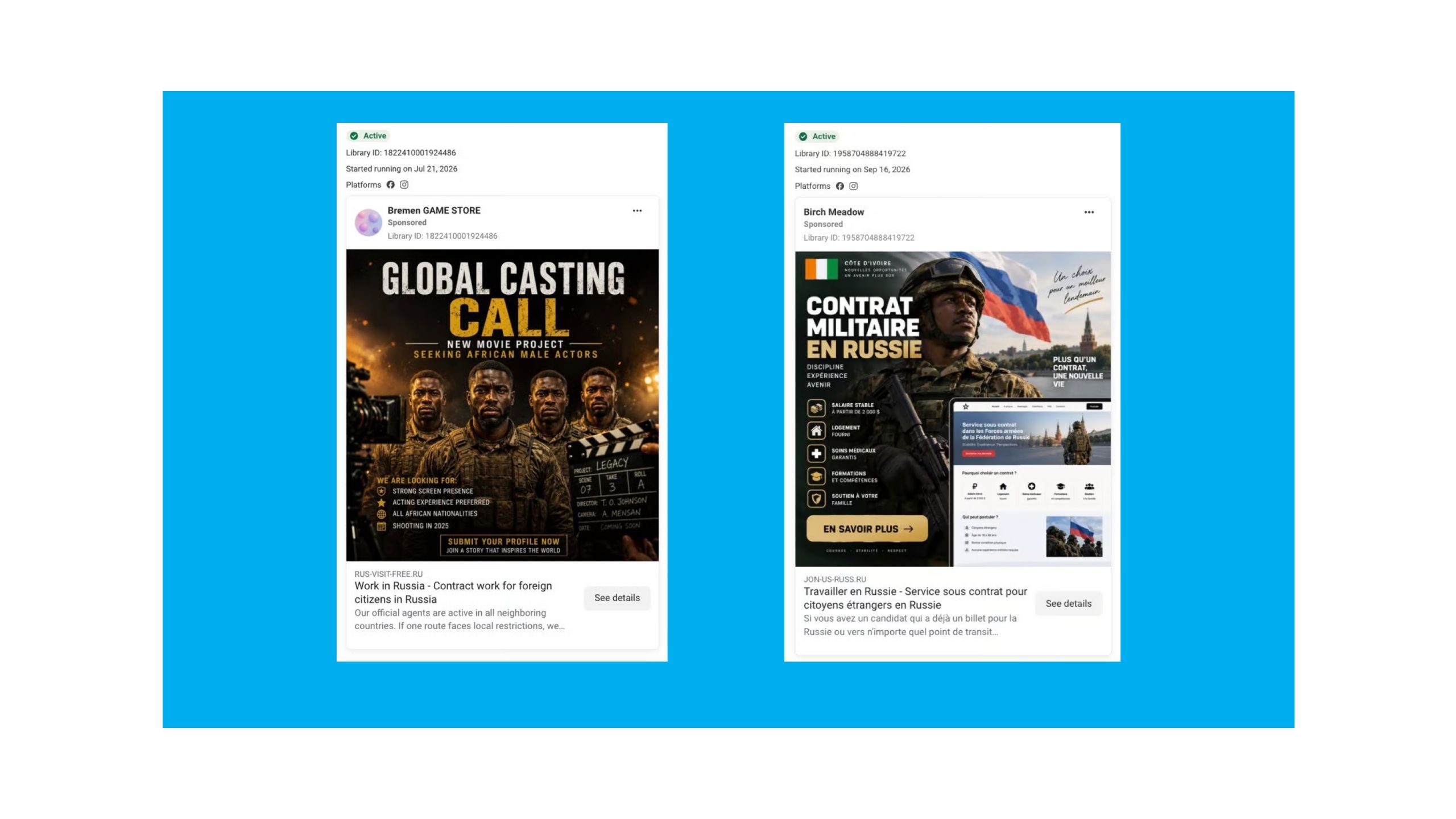
Code for Africa, a non-profit network of African digital-democracy labs, shared a new investigation with POLITICO showing that a Russian military recruitment network targeting workers across Africa, Asia, and Belarus relies on Western advertising and tracking technology from Meta and Google to reach recruits and measure its campaigns, according to reporting by Antoaneta Roussi published September 21.
89 Websites and Counting
Researchers identified 89 websites, seven social media or Facebook accounts, and 39 messaging accounts or channels tied to the network, with new ones appearing daily. The pitch almost never mentions war: ads posing as ordinary staffing agencies promise construction work, security jobs, a film role, or help getting a Russian visa. Some of the recruitment websites even carry the logos of Western news organizations like the BBC, falsely implying an endorsement.
A "Casting Call" for Soldiers
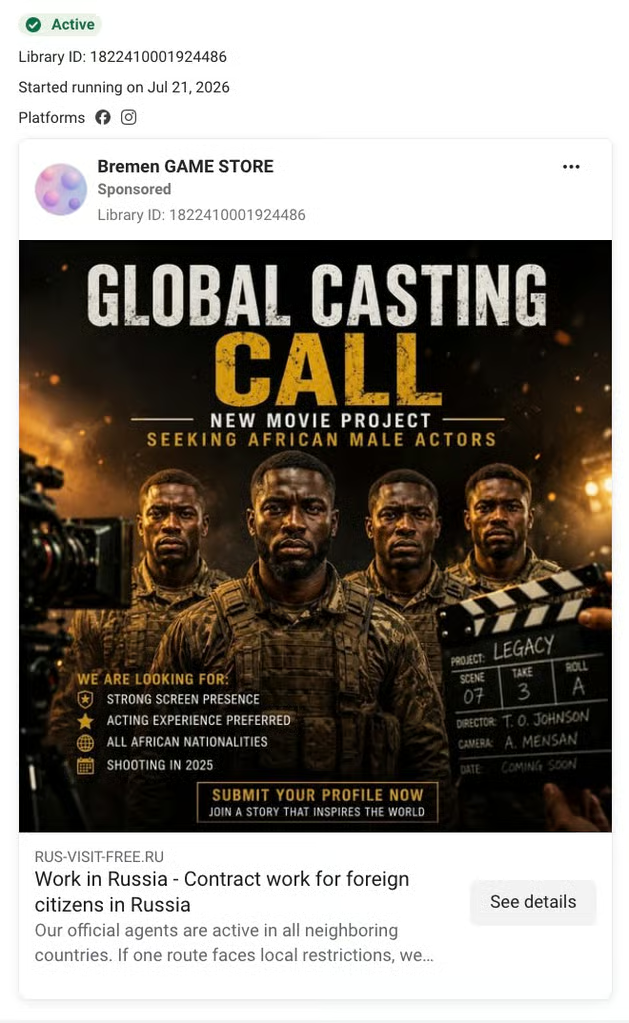
One "global casting call" ad reviewed by POLITICO sought African male actors for a supposed film project, illustrated with an AI-generated image of Black men dressed as soldiers over the words "shooting in 2025"; it was found on a Facebook page based in Germany. Another, sponsored by an account called "IRC Russian Bear," showed a Black soldier with Russian flags stitched to his uniform, promising $15,000 immediately upon signing plus a $3,000 monthly salary: "A chance to change your life."
Built on Western Infrastructure
The investigation found the network's flagship recruitment brand was hosted on a server in Amsterdam, its websites were built using AI tools from companies in the US and Sweden, and application forms recruits filled out ran on software from an Austrian company before their personal data was sent on to Russia. "Behind that Western layer sit ordinary Russian commercial hosts, and behind those a bulletproof-hosting tier built to survive complaints," the researchers wrote. "The result is that a war sold to Africans, Asians and Belarusians is sold with the tools of the countries that publicly oppose it." Meta has taken down more than 300 ad campaigns linked to the recruiters so far, according to Code for Africa director Justin Arenstein.
Warnings That Depend on Your Language
Searches run from inside the EU for Russian-language terms like "contract service" or "engineer contract for foreigners," or the English phrase "join Russian army as a foreigner legal benefits citizenship," led directly to recruitment websites. Researchers also found that Google's AI-generated search summaries displayed risk warnings prominently for searches in EU languages, while the same warnings appeared much further down the page for other languages. Google spokesperson Alex McPhillips disputed some of the investigation's claims - specifically that most of the identified sites used Google ads - but said the company is "actively investigating" its other findings, adding: "We have strict policies and systems governing our products that are designed to protect people and ensure access to reliable information, and we take enforcement action when we find violations."
Reaching the Highest Levels of Diplomacy
There's no independently verified total for how many foreign recruits the network has produced, but Ukrainian officials estimate that at least 2,982 people from 40 African countries have been recruited to fight for Russia. Moscow disputes claims of organized recruitment and maintains that African recruits joined voluntarily - a denial consistent with the pattern of institutional deflection we've documented before across Russian embassies worldwide. The issue has reached senior diplomatic levels: in March, Kenya's Foreign Minister Musalia Mudavadi raised it directly with Russian Foreign Minister Sergey Lavrov, and South African President Cyril Ramaphosa reportedly discussed it directly with Vladimir Putin. However, in most cases Russian diplomacy excercises denial as its core strategy.
Part of a Larger Propaganda Machine
Will Brown, a senior fellow at the European Council on Foreign Relations, said Russia has built an "immense propaganda system" aimed at Africa, involving tens of thousands of bots, influencers, and content marketers casting Russia as a champion of freedom, sovereignty, and African dignity. "At first, we thought this propaganda system was just being used to shift public opinion," Brown said. "But now it's clear the system is also being used to traffic desperate young men to the frontline." He said recruits describe racial abuse, stolen wages, contracts they don't understand, and as little as a week of training before being sent into a minefield.
A Separate Pipeline for Women
Brown said the ECFR separately identified a significant network recruiting African women for jobs in Russia's drone and weapons factories, with ads appearing on online forums and even public billboards in major African cities such as Nairobi - a pattern that echoes recruitment schemes like Alabuga Start, which we've covered before. "Like the men, they are tricked and coopted," Brown said, but added that escape can be even harder for women, who often find themselves far from African embassies and other sources of help.
Before You Click "Apply"
Anyone who comes across one of these ads - a staffing agency, a "casting call," or an offer to help with a Russian visa - should treat it as a red flag rather than an opportunity. Many foreign nationals lured by ads like these ended up dead. Anyone already in Russia's armed forces who wants out has a safe option through Ukraine's "I Want to Live" project - also see our FAQ on how to safely surrender to Ukrainian forces.