August 18, 2026
Russia Won't Tell Kenyan Families Whether Their Sons Are Alive. A Shadowy Russian Network Will - For 30%.
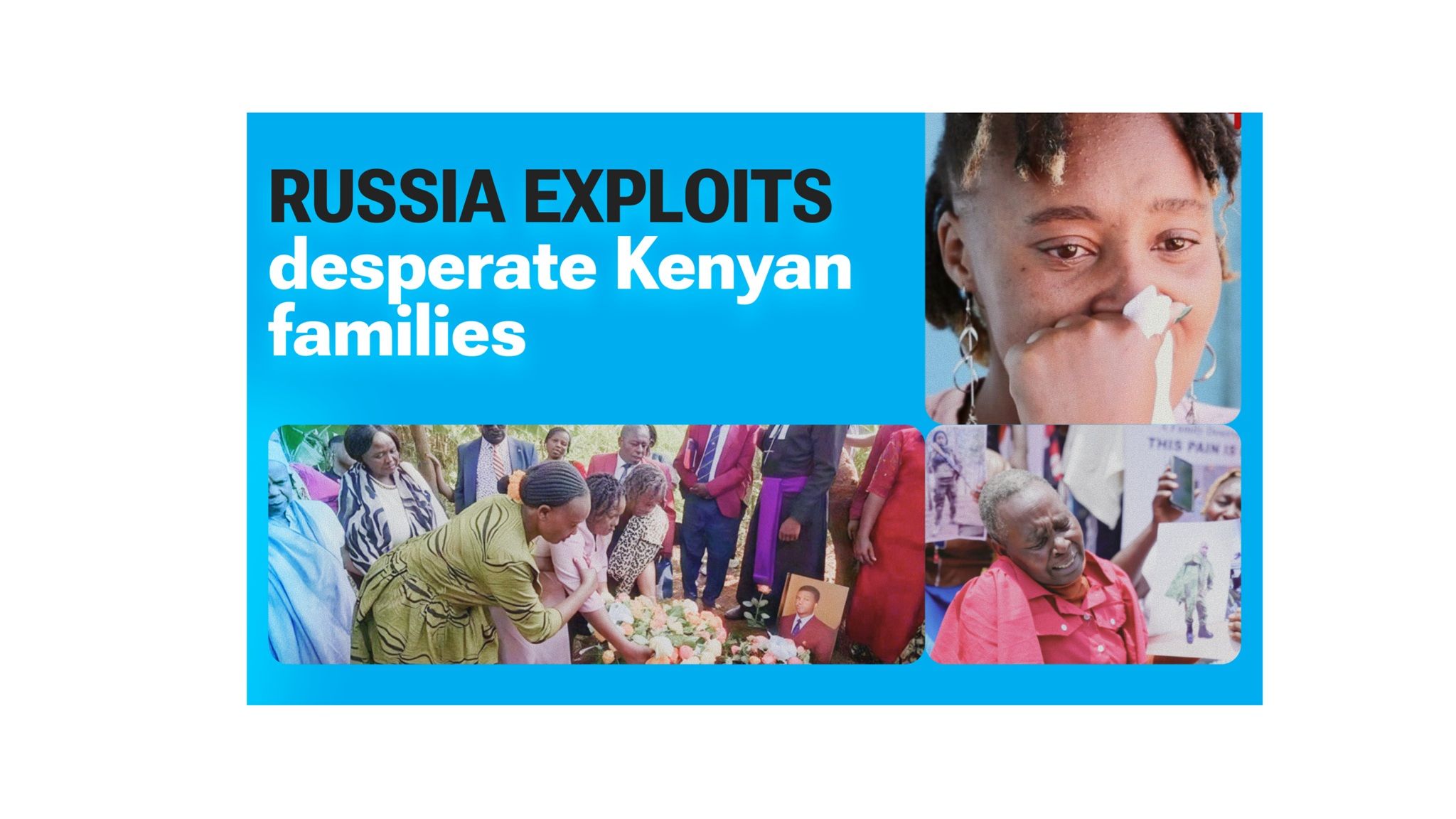
Russia has provided no official confirmation of status - alive, dead, or captured - to the families of the roughly 1,000 Kenyans the National Assembly was told had been recruited to fight in its war in Ukraine. Into that silence, a network of intermediaries has moved. They have the names. They have the next-of-kin information. They have a fee schedule. And they are trying to take advantage of the grieving Kenyan families one by one.
The investigation, published by The Nation in The Weekly Review on August 8, 2026 and reported by Rosemary Tollo, documents how a Russian man known to affected families only as "Alex" or "Alexey" has positioned himself as a broker between the Kenyan families and Russian systems that Russia's own government refuses to engage with officially.
The Offer
Alex's pitch: he can secure compensation of up to Sh19.4M (~$150,000) per case, within 60 to 90 days. His fee is 30 per cent. With approximately 100 families already organized into a group in Nairobi, and assuming every claim reached the maximum, Alex stands to collect as much as Sh582 million ($4.5 million). He kept his camera off during family video calls and asked that his role be kept secret. No family interviewed reported ever seeing his face.
He has produced no official letter authorising him to act on behalf of the Russian government or military, no registered business address, no verifiable credentials for the Moscow lawyer he claimed would handle the cases. What he does have - and this is the detail that matters - are the names of people already identified as next of kin in recruits' Russian military contracts. The Russian military recorded these families. Russia will not speak to them. Alex will, for a fee.
Kelvin Ochieng, identified by families as the Kenyan intermediary communicating with them in Swahili and Sheng on Alex's behalf, told a Nation reporter posing as a relative of a deceased recruit that if documents establishing the relationship were accepted, the family could qualify for a visa to travel to Russia. The families would be responsible for preparing and notarising documents and paying their own legal fees. Alex's team would take Sh2 million after the money reached the bank account - on top of his 30 per cent commission.
To secure the release of a Kenyan prisoner of war, Ochieng first quoted Sh1 million (~$7,750). He then revised this to Sh3.2 million (~$24,800), without being able to identify the specific prisoner involved.
When asked by the reporter whether the group included around 100 families, Alex asked: "Are they all united?"
A forthcoming report by Journalists for Justice documents a further layer of the same pattern: Kenyan recruits who traveled to Russia through local agencies had their Russian bank accounts opened under the supervision of Russian handlers, who retained access through powers of attorney. The compensation money, like the signing bonus before it, flows toward the handler. The family waits.
Festus Omwamba, currently facing charges for trafficking 25 Kenyans to Russia through deceptive job offers, was separately offering to connect affected families with people he said could help obtain information and compensation. He was released on a Sh5 million (~$38,750) bond in March 2026.
What Russia Is Actually Doing
Nothing. That is the point.
See also: Russian company plunders Ugandans before they even arrive to Russia
Ukrainian officials have publicly warned families against sharing personal information with unauthorised intermediaries or paying anyone to secure a place on an exchange list. Prisoner exchanges since 2022 have been handled exclusively through the Coordination Headquarters for the Treatment of Prisoners of War. Kenyan nationals who were lured into Russia's army are held captive in Ukraine: Ukraine publishes names. Russia does not.
Russia's offer to release a foreign POW in exchange for money - mediated through an anonymous figure who will not show his face - is not a diplomatic process. It is a monetisation of captivity. Russia recruited these men, sent them to the front, and can no longer account for them. Their families are now being charged for information Russia possesses and will not share. The intermediary network exists because Russia created the conditions for it: no official channel, no confirmed status, no body, no return - and a family desperate enough to pay someone who claims to know.
If Your Relative Has Gone Silent
Families who have lost contact with relatives who traveled to Russia and stopped communicating can reach Ukraine's I Want to Find, which helps locate people who entered Russia's military pipeline. It is an absolutely free official governmental project that never charges anything from relatives of the missing, killed and captured servicemen of Russia's army. More directions on how to act if your relative has gone missing in Russia can be found here.
Source: Daily Nation