October 23, 2026
Russian Ambassador to Ghana Calls Recruitment Claims "Simply Untrue" as Ghana Says 272 Citizens Were Drafted
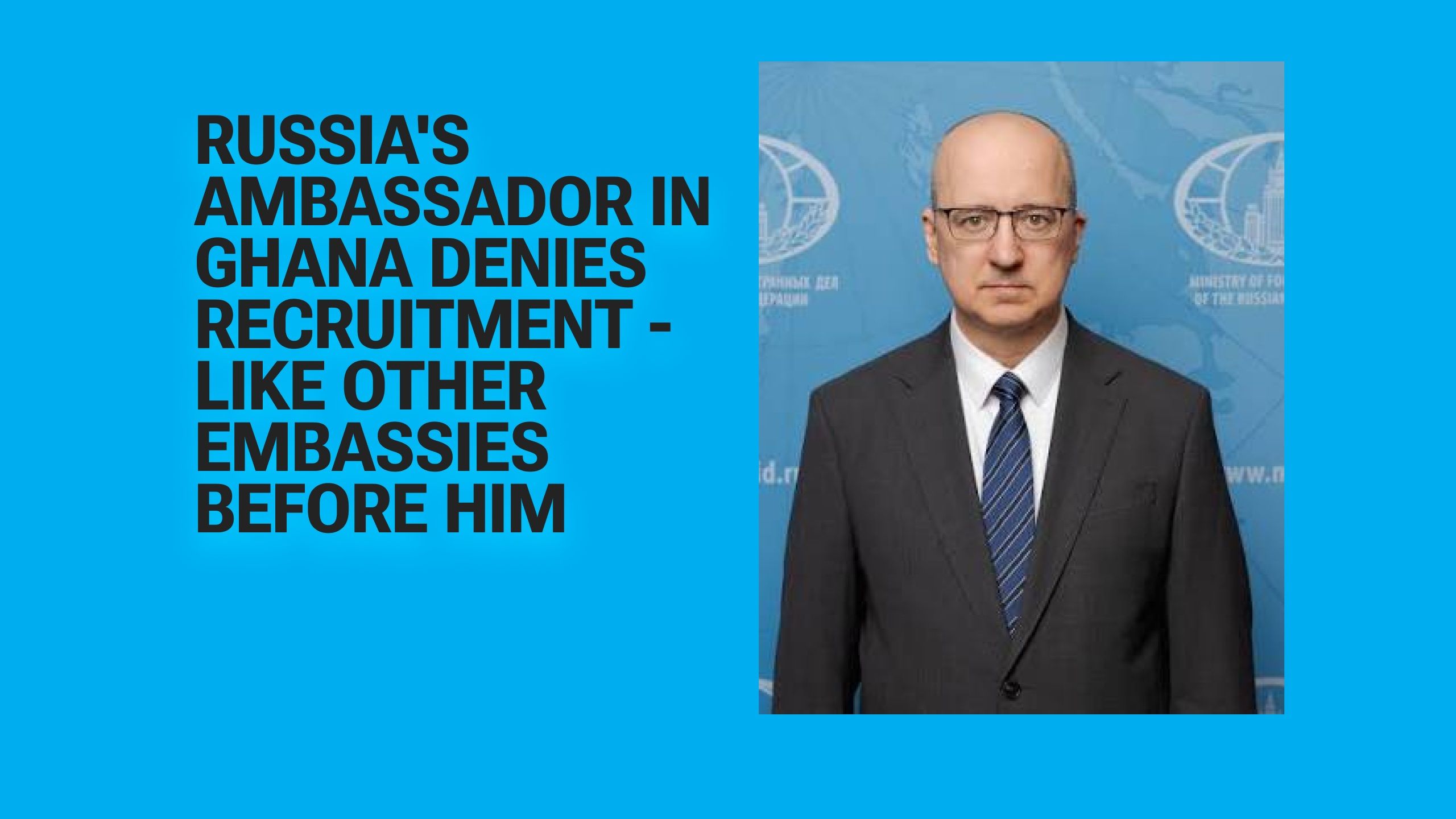
Russia's ambassador to Ghana, Andrei Ordash, has denied that Russia is deliberately involved in any unlawful recruitment of citizens of African states, GraphicOnline reported on October 7, 2026. "Allegations that Russia is deliberately involved in any unlawful recruitment of citizens of African states are simply untrue," he told the Ghanaian news outlet in an interview in Accra. The denial follows a familiar script: Russian embassies on several continents have said much the same, as we showed in our earlier article.
What Russian Ambassador Said
Ordash said Russia understands that the Ghanaian government is worried about its citizens, and that it is natural for any state to want to find out how its people ended up in a war zone. But he said two situations must be kept apart. Russian law, he said, allows foreign nationals to serve in the military on a contract. If an adult makes that choice voluntarily and understands what the contract means, he said, being a foreigner does not by itself make the service unlawful.
A different situation arises, he said, if a person was deceived, forced, or misled about the work or the terms of the contract, or was the victim of a criminal scheme. He said such cases must be investigated. The embassy said that if credible information appears about any Ghanaian who was unlawfully drafted, it is ready to review it through the relevant authorities and pursue the necessary remedy.
What Ghana Has Said
GraphicOnline noted that on July 28, 2026, it reported that Ghana's government had launched investigations into alleged criminal networks recruiting Ghanaians for Russia's war, after 272 Ghanaians were reported to have been drafted through fraudulent overseas job schemes. According to that report, Foreign Minister Samuel Okudzeto Ablakwa said 55 of the cases involved Ghanaians who had died in the war and two others were prisoners of war. He also said that, from information gathered on his visit to Kyiv, about 1,780 African nationals from 36 countries have joined Russian forces. These are his estimates as reported by GraphicOnline.
The paper also recalled a September 10, 2026 Amnesty International briefing, which said Russia had used deceptive, coercive and exploitative practices to recruit foreign nationals, mostly from low-income countries, and a February 25, 2026 Reuters report, in which Ukraine's Foreign Minister Andrii Sybiha accused Russia of using deception to recruit more than 1,700 Africans. Sybiha made the claim at a news conference in Kyiv with Ablakwa.
The Same Denial, Embassy After Embassy
Ordash's answer is not new. It closely matches the pattern we set out in The Ministry of Denial, our September 14, 2026 look at how Russian embassies respond when recruitment of their host country's citizens comes to light. We described a set of repeated moves: reports are dismissed as propaganda or fabrication; blame is pushed onto unnamed "illegal" groups or middlemen; recruits are described as volunteers who understood their contracts; the embassy cites Russian law and offers "dialogue"; and when the numbers become too large to deny, it admits there is a problem but rejects any responsibility. In Ghana, the ambassador uses several of these at once.
The "voluntary contract" argument is almost word for word what the Russian embassy in Kenya said on February 19, 2026, when it called reports of recruitment "misleading propaganda" and said Russian law allows voluntary foreign enlistment, even though Kenya's intelligence service had told parliament that more than 1,000 Kenyans were fighting in Ukraine. In Indonesia, Ambassador Sergei Tolchenov denied any recruitment on September 1, 2026, four days after Ukraine's Foreign Intelligence Service published documents on eight Indonesians, and said joining was a personal choice. In Peru, the embassy's August 15 statement blamed unidentified individuals for deception and said those who signed understood their contracts, after a CNN investigation found at least 800 Peruvians fighting for Russia.
The "blame the criminals" line is also familiar. After a CNN investigation, Russia's ambassador to Nigeria denied any government-backed programme and said illegal groups act outside the law, while at least 25 of more than 215 documented Nigerian recruits were dead or missing. In Iran, the embassy called recruitment flyers circulating near its Tehran building "forgeries of a criminal nature". In Colombia, the embassy dismissed a Noticias Caracol report as scripted, while families protested outside it. In Ethiopia, staff at the Addis Ababa embassy were reported to have collected documents from people queueing there in April 2022, while the press attaché denied any recruiting. In India, the embassy denied any fraudulent scheme in August 2024, yet in September 2026 Kremlin spokesman Dmitry Peskov spoke of compiling a list of Indians still serving, and an earlier promise to send them home was not kept.
Put side by side, the statements use the same few lines in country after country, and in each the problem is said to lie somewhere else. Ghana, where the government reported 272 cases, has now been given the same answer.
An Offer of Security Cooperation
In the same interview, Ordash said Russia is ready to deepen security cooperation with Ghana in ways that match Ghana's own needs and national interests. He named the fight against terrorism and extremism as the most obvious area, pointing to the threat spreading from the Sahel towards the coastal states of West Africa, and listed counter-terrorism training, threat analysis and border security among the things Russia could share.
A Safe Way Out
Ghanaians and other foreign nationals lured into Russia's armed forces have an option to safely escape the battlefield with Ukraine's "I Want to Live" project. See our FAQ for recommendations for victims of Russian military recruitment and their families.