August 22, 2026
South Africa Is Better at Investigating Russian Recruitment Than at Preventing It. A Policy Analyst Mapped Five Reforms to Fix That.
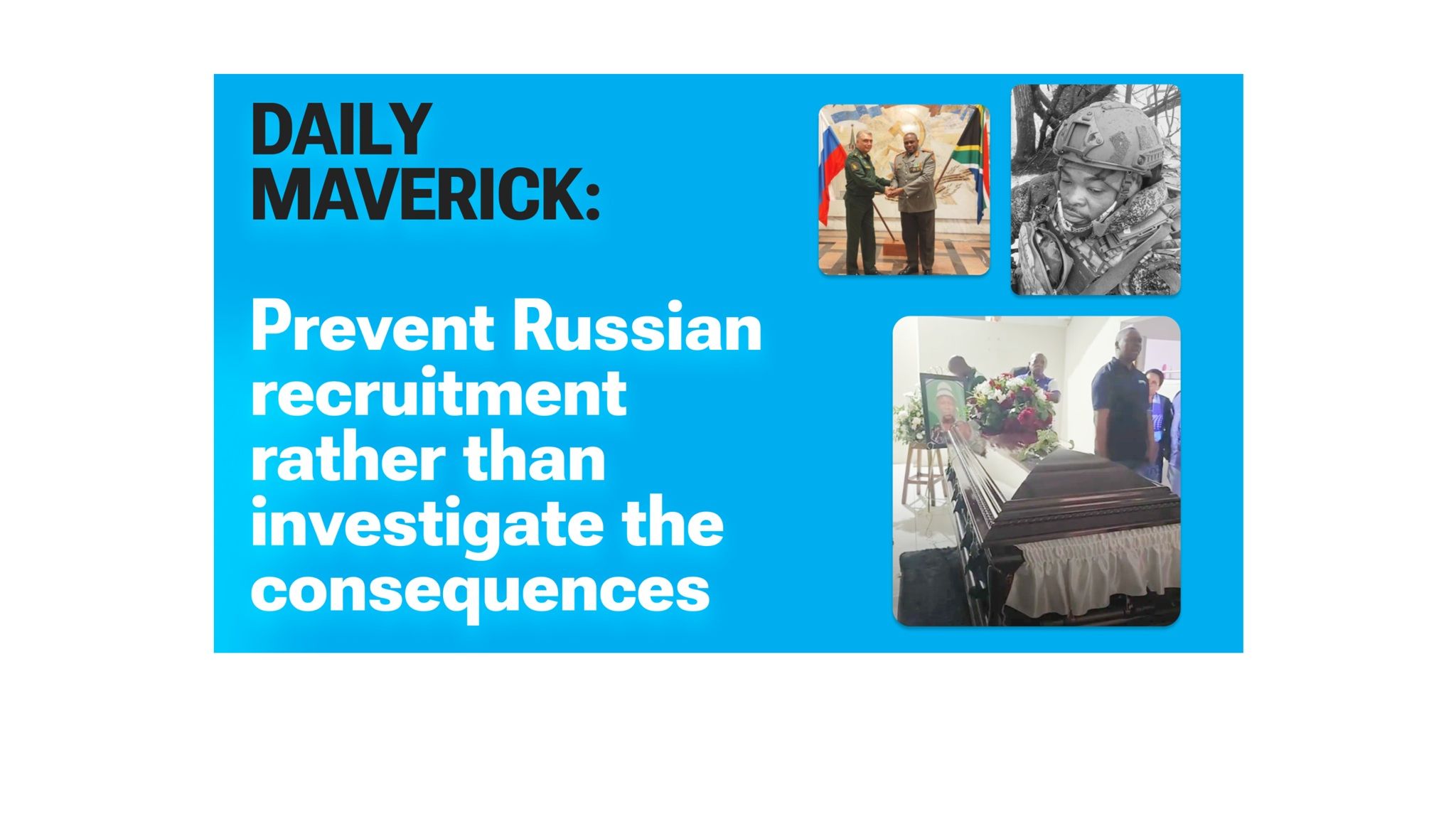
In February 2026, South Africa's Presidency confirmed that 17 citizens - men aged between 20 and 39 - had sought government assistance after being lured into Russia's army. Officials described them as having been drawn into "seemingly mercenary activities" after allegedly being offered lucrative employment abroad. Relatives said some had expected security or bodyguard training, not frontline deployment. Pretoria engaged with Moscow, secured the return of part of the group, and pursued related investigations under the Regulation of Foreign Military Assistance Act.
Writing in Daily Maverick, political risk analyst and Research Fellow at the Africa Centre for Critical Minerals and Energy Transition Wellington Muzengeza argues that the episode points to a structural problem South Africa has not yet addressed. Its existing legal framework, he writes, is a criminal and security instrument: it defines mercenary activity and prohibits it. What it does not provide is "a system for verifying an ostensibly civilian foreign vacancy, identifying an intermediary's beneficial owners, translating contracts or alerting relevant authorities when the stated job conflicts with the visa, employer or destination."
The gap, Muzengeza argues, is one of institutional fragmentation. A recruiter presents an offer as employment. Home Affairs sees travel documents. An airline sees a ticket. A bank sees a payment. Dirco - the Department of International Relations and Cooperation - may only learn of the case after a distress call from the field. "No institution necessarily sees the pattern."
The Five Reforms
Muzengeza proposes five concrete changes.
First, regulate overseas-placement intermediaries. Any agency that regularly arranges overseas work, training or work-study placements for payment should be required to register with the Department of Employment and Labour. Registration would require disclosure of beneficial owners, the foreign employer, destination workplace, visa category, worker fees and travel sponsor. The register of compliant, suspended and prohibited agencies should be public.
Second, erify high-risk placements before departure. Risk indicators - active conflict zones, military or dual-use workplaces, tourist visas paired with paid work, unverifiable employers, worker-paid recruitment fees, travel financed by undisclosed parties - should trigger pre-departure checks. Contracts should be provided in advance, translated where necessary, and matched to the stated employer, workplace and visa. Workers should receive clear information about passport retention, termination rights, return travel and consular assistance. Muzengeza is explicit that this is "targeted verification, not state approval of every overseas job."
Third, connect labour oversight with lawful referrals to travel, financial and criminal authorities. The Department of Employment and Labour should lead the overseas-placement system, supported by a formal referral protocol with Home Affairs, Dirco, the Hawks and - where statutory thresholds are met - the Financial Intelligence Centre. Referral triggers could include group travel funded by undisclosed sponsors, conflicting visa and employment information, or military-style training presented as ordinary work. Muzengeza specifies that controls must be based on "conduct and documentary risk, not nationality, race or political affiliation."
Fourth, require transparency for overseas employment advertising. Platforms should be required to verify advertisers of recruitment content targeting South Africans, label sponsored recruitment material, retain payment and targeting records for a defined period, and provide accessible complaint channels. The objective, Muzengeza writes, is "evidence and accountability, not indiscriminate removal of 'suspicious' speech."
Fifth, establish a victim-centred return protocol. Returnees should receive trafficking screening, independent legal advice, and medical and psychological assessment on arrival. Families of those who are injured, missing or killed should have a designated government liaison. Support should be separated from criminal-liability decisions: "screen first, investigate fairly and prosecute only on individual evidence."
The Broader Pattern
Muzengeza places the South African cases within a wider documented pattern. Ukraine's foreign minister stated in February 2026 that more than 1,780 citizens from 36 African countries were serving in Russian forces; Coordination Headquarters for the Treatment of Prisoners of War put the cumulative figure at 2,982 by May. These figures come from a party to the conflict, and Russia denies illegally recruiting Africans. An April 2026 investigation by FIDH, Truth Hounds and the Kazakhstan International Bureau for Human Rights estimated at least 27,000 foreign nationals from more than 130 countries had been recruited into Russian forces since 2022, identifying elements of deception, coercion and trafficking within the wider system.
The analyst also notes a lesson from Kenya: after heightened scrutiny was introduced at Nairobi's main airport, some travellers were rerouted through neighbouring states. "A recruitment network disrupted in one jurisdiction may shift across a regional border." He recommends South Africa seek a SADC protocol for sharing information on sanctioned recruiters, verified recruitment methods, missing persons and evidence-preservation requests.
[A SADC protocol is a legally binding agreement signed by member states of the Southern African Development Community (SADC). It turns the group's regional goals into practical rules. These rules cover areas like trade, politics, health, and security. - Ed.]
Parliament has an immediate vehicle for reform: the Employment Services Amendment Bill, introduced in 2026, would expand the minister's powers to regulate recruitment and placement of South Africans for work abroad. Muzengeza argues Parliament should use it to establish preventive safeguards rather than wait for another crisis.
"Sovereignty must travel with the citizen," he concludes.
Source: Daily Maverick