August 27, 2026
From the Far Left to the Manosphere: How Russia Recruits Foreign Influencers to Sell Its Military - and Why the Tate Brothers Are Now Under UK Counterterrorism Scrutiny.
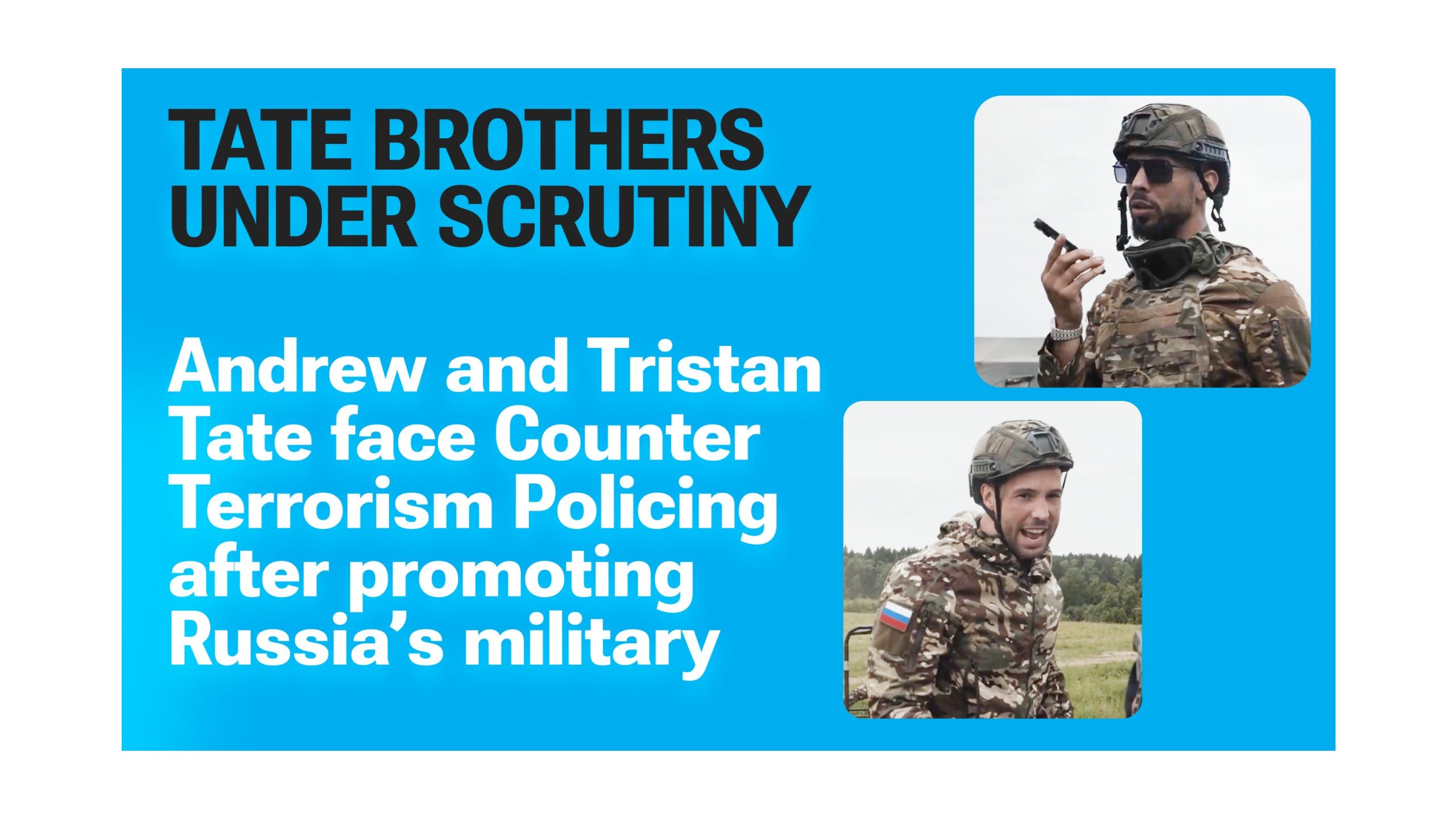
UK Conservative MP Alicia Kearns has referred Andrew and Tristan Tate to Counter Terrorism Policing and written to Security Minister Dan Jarvis after the brothers posted a 40-minute video of themselves taking part in military training on Russian soil. The referral, made in August 2026, concerns a June visit to Russia that the brothers filmed and published under the title Tate Confidential: The Money Cow Part 2.
Kearns, the former chair of the Foreign Affairs Select Committee and current Conservative shadow safeguarding minister, argues the trip raises questions about whether the Tates were required to register under the Foreign Influence Registration Scheme (FIRS), introduced as part of the UK's National Security Act. The scheme requires individuals to register arrangements under which they carry out activities in the UK at the direction of, or on behalf of, a specified foreign power. Failure to register carries a maximum sentence of five years' imprisonment.

The Tate brothers categorically deny the allegations. A representative told LBC that the visit was "private and personal," that the brothers "received no payment, compensation, financial assistance, logistical support, or direction from the Russian state," and that they "were not instructed to promote any Russian government message." No charge has been brought against either brother and no authority has made any finding that they breached FIRS.
What the Video Shows
The footage documents a tour of Russia that includes visits to the Kremlin, Red Square, St Basil's Basilica and Chess Square, where the brothers make jokes about George Floyd and display their wealth. The longest segment shows them at a military training ground dressed in military-style camouflage and body armour, wearing helmets and, in several clips, Russian flag patches.
The full video posted by Andrew Tate on X:
In the training sequence, Andrew and Tristan ride on and inside a Soviet-era T-80BV main battle tank - a gas-turbine powered vehicle still in active use by Russian forces in Ukraine. They strip and reassemble a Kalashnikov-pattern assault rifle, fire weapons on a range, throw hand grenades from a trench, use a grenade launcher and operate what is described as a flamethrower. At one point, the "commander" overseeing the exercises jokes that whoever finishes the obstacle course fastest will receive a "special medal of the Minister of Defence of Russia." The brothers are also filmed singing "Katyusha," the Soviet wartime song.
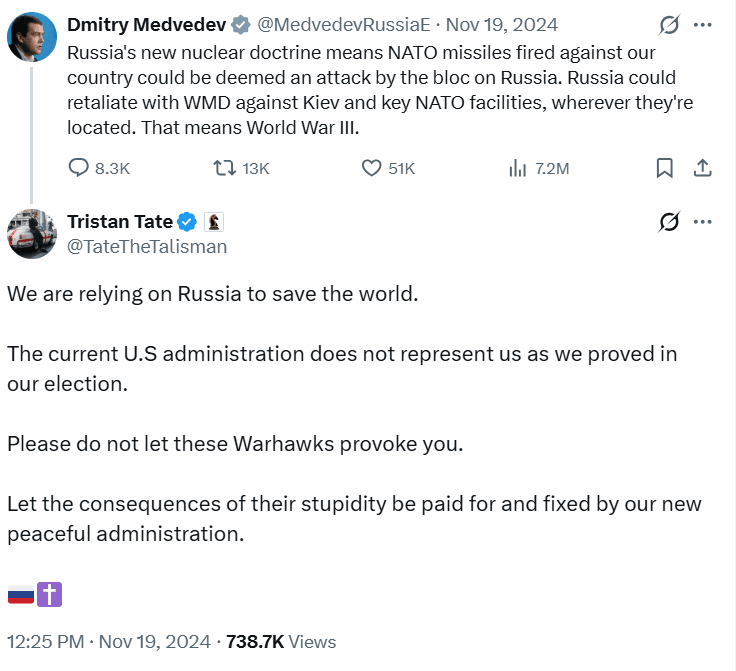
Tristan Tate has a documented history of posting pro-Russia content. In October 2024 he wrote that "Russia is a manufactured boogeyman." In November 2024 he tweeted at former Russian President Dmitry Medvedev to say that "we are relying on Russia to save the world."
Russia Does Not Care Who Promotes Its Military
The Tates are not an anomaly. Russia has consistently used foreign influencers - across the full political spectrum - to glamourise its military and generate sympathy for its war. The selection criterion is not ideology. It is reach, radicalism, and willingness to promote Russian militarism to an audience that official Russian state media cannot easily access.
We documented this pattern in detail in our reporting on Sovintern - Russia's use of Western leftist networks to push pro-Kremlin narratives and facilitate recruitment. The same infrastructure that funds far-left anti-NATO content funds far-right strongman content. The message is packaged differently for different audiences; the origin and the purpose are the same.
The case of Kemi Seba - the pan-Africanist influencer who received $700,000 from Prigozhin's network and built a following across Africa on anti-colonial rhetoric, and who is now facing terrorism charges in Benin while awaiting extradition proceedings in South Africa - is another version of the same playbook. Russia does not care whether the useful voice belongs to a Black radical, a European socialist, or a Western "manosphere" influencer. It cares whether that voice reaches people who might otherwise ignore Russian state media, and whether it makes Russia's military look legitimate, powerful and worth joining.
Content like the Tates' tank video does exactly that. To a young man with no context for what the Russian military actually does to its foreign recruits, the footage communicates a simple message: Russia is powerful, joining feels exciting, and these men did it and came home with a story to tell.
What the Video Does Not Show
Bradley Townsend, 33, from Barnsley, South Yorkshire, also apparently found Russia's military appealing enough to travel for. He appeared in a video posted to a Russian propaganda account in April 2026, describing himself as "a normal working-class lad from Yorkshire" and saying he understood he "probably won't be able to go home." He was killed on June 10 in an FPV drone attack near Liman in the Donetsk region - the first British national confirmed killed while fighting for Russia in the conflict. The FCDO confirmed his death and noted its ability to provide consular support was "severely limited."
Townsend's experience - not the tank ride - is the representative one. Foreign nationals who sign contracts with the Russian army consistently report being deceived about the nature of the work, coerced into frontline deployment, denied their passports, and sent to the front with minimal training. Ukrainian intelligence has documented thousands of foreign nationals killed in action. The Danish Institute for International Studies, which interviewed 18 foreign fighters captured as POWs in Ukrainian camps, found that fighters were held in place through debt, threats of violence and administrative coercion - not the kind of content that makes it into a 40-minute YouTube feature.
The Tates' video is not a neutral record of a tourist trip. Whether or not it meets the legal threshold for registration under FIRS, it functions as a recruitment advertisement - one that reaches tens of millions of people and portrays participation in Russia's military as an adventure - but without describing the actual reality foreign recruits face.
A Safe Way Out
Anyone who was coerced, tricked or lured into Russia's army can escape the tragic fate many foreigners faced - by reaching out to Ukraine's "I Want to Live" project. All the information shared with the project are treated with confidentiality.