July 20, 2026
Banned but Still Running: Russian Military Recruiters Are Using 40+ Facebook Pages to Target Men in Indonesia and Cambodia

Meta banned advertising from Russia in 2022. Russian military recruiters are still running paid ads on Facebook and Instagram.
That is the central finding of a weeks-long undercover investigation by Germany's Tagesschau, published through its Rabbit Hole investigative format. The team documented recruitment ads, joined Telegram channels, spoke to a recruiter by phone, and tracked a training camp to a rehabilitation centre in Yaroslavl, Russia. What they found is a sophisticated, adaptive recruitment machine - and a set of social media platforms that have repeatedly failed to shut it down.
WorkVia: Russia's Recruitment Agency for Asia
The investigation centres on an organisation called WorkVia, which promotes itself through the website jobsinrussia.ru and runs Telegram channels, Instagram posts, and paid Facebook advertisements. The pitch is simple and consistent: men from Indonesia and Cambodia are promised $3,200 USD per month in salary and a $30,000 USD signing bonus to join the Russian army. No military experience required. Additional combat bonuses are offered for territory advanced, enemy equipment destroyed, and drones shot down.
"Tired of earning less than $500? I've found a way to make $5,000 in Russia," reads a typical Instagram post, targeted at Indonesian men. The posts are put out by bot accounts. The ads are paid. Both are prohibited under Meta's own policies.
WorkVia has been active since at least October 2025 and has been posting heavily since then - video testimonials from recruits, instructions for how to apply (including mandatory pre-screening for HIV and tuberculosis), and promotional content designed to look like a legitimate employment service.
Editor's note: We have documented numerous cases where recruits who accepted similar offers never received what was promised. Elena Smirnova, a Russian travel agent who ran a recruitment pipeline for Cuban and Sri Lankan nationals, was arrested in April 2024 after fighters filed police complaints stating money was being taken from their bank accounts - accounts they had handed over because they could not read Russian. A court document showed she admitted to embezzling the pay of hundreds of recruits. In a separate Brazilian case investigated by The Insider, recruits were walked through a power of attorney signing on arrival in Russia and their accounts were subsequently drained - one fighter lost approximately 2 million rubles [~$27,600 USD] before he realised what had happened. The numbers in the ads are real. Whether they arrive in the recruits' accounts is another matter.
WorkVia has been active since at least October 2025 and has been posting heavily since then - video testimonials from recruits, instructions for how to apply (including mandatory pre-screening for HIV and tuberculosis), and promotional content designed to look like a legitimate employment service.
The Undercover Call
The Tagesschau team found a Russian phone number linked to WorkVia's Telegram channel. When they saved it to WhatsApp, a woman's profile photo appeared. A journalist contacted her undercover, posing as an Indonesian man interested in joining the Russian military.
The woman, who gave her name as Christina, called back. She confirmed that WorkVia is "a firm that brokers contracts to the Russian Defence Ministry." When the journalist asked whether the job was dangerous, her answer was direct: "It is risky. The job is risky, but also well paid."
Tracking the Training Camp
WorkVia posts videos and photos from what it describes as its recruits' training camp. Some images, the team found, were stolen from unrelated sources - a photo supposedly showing recruits playing in the snow at the camp turned out to be from a years-old news article about foreign students in Russia.
But other images appeared genuine. One showed a man in a grey hoodie standing next to a statue of Baba Yaga - a witch figure from Russian folklore. It was posted in November 2025 with a caption stating it was taken at the training camp.
Weeks of searching followed. The team eventually found a separate Facebook post by a Georgian man - Dimitri K. - showing the same Baba Yaga statue, taken at roughly the same time. The fence, the background, the angle all matched. Dimitri's VK profile showed he followed Russian recruitment accounts.
The Tagesschau team contacted Dimitri. He did not respond. They reached his mother in Georgia. She said he had previously lived in Germany before being deported to Georgia, where he worked as a baker. Unable to earn enough, he went to Russia. She had not heard from him since November 2025.
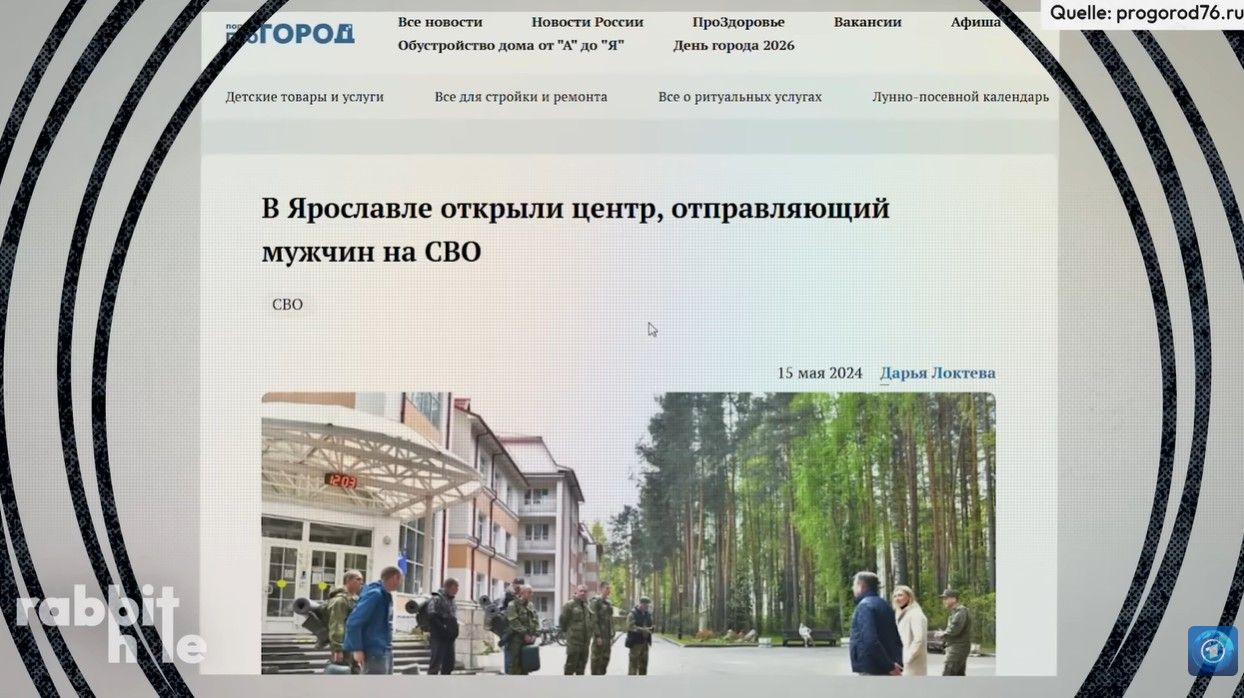
The camp itself was eventually located by tracking a pair of distinctive red drainpipes visible in two WorkVia Telegram photos. A reverse image search led to a rehabilitation centre in Yaroslavl, Russia. Once the location was confirmed, almost every detail matched - the fairy-tale figures, the forest path, the buildings, even the sofas. A Russian media report confirmed that soldiers are housed, medically examined, and equipped at the facility before being sent to the front.
Who Runs WorkVia?
The website's registration data lists one name: Natalya K. She has a staffing company registered in her name. A job posting from that company explicitly listed recruitment for Russia's Air Force. When Tagesschau contacted her, she said her identity had been stolen to register the website and that her firm only handles civilian placements. Shortly after, her firm's profiles and the Air Force job listing disappeared from the internet.
The Pivot to Asia
Africa was Russia's primary foreign recruitment ground through 2024. It is becoming harder to operate there. Governments in South Africa, Kenya, and Ghana have launched police investigations and raids against recruitment networks following public pressure and civil society backlash. According to political scientist and conflict researcher Tim Glawion of the University of Freiburg, interviewed for the investigation: "In South Africa, in Kenya, in Ghana, there are now - after there was backlash from the civilian population and from the opposition - there are now manhunts, there are raids against these networks."
Ukraine's Defence Ministry confirmed to the Tagesschau team that Russia has an internal list of 36 countries from which recruitment is restricted - countries whose governments have reacted strongly enough that Russia has decided to avoid them, "in order not to provoke negative reactions from the leadership of these countries."
The response has been a geographic pivot. Since February 2026, WorkVia has shifted its focus almost entirely to Cambodia and Indonesia - two countries where Russia has barely operated before and where awareness of the recruitment threat is low.
A Platform Problem Without an Easy Answer
Meta prohibited Russian advertising on Facebook and Instagram in 2022. The Tagesschau team spent months reviewing Meta's own ad archive and found more than 40 different Facebook pages running advertisements that recruit for the Russian military. Each page represents a recruitment operation similar to WorkVia.

When Tagesschau shared examples with Meta, at least one WorkVia-linked Facebook page was taken down. A new one appeared shortly after.
The pattern - page removed, new page created, ads resume - illustrates a broader challenge platforms face with state-linked influence operations that deliberately adapt to evade detection. Recruiters operate across dozens of accounts, use stolen identities, and quickly reconstitute when one channel is closed. Reactive enforcement, page by page, struggles to keep pace.
The academic framing offered by Tim Glawion cuts through the abstraction: "These foreign recruited forces are, as some reports show, unfortunately often cannon fodder. The political costs when these people die are not as high."
That calculus works for Russia precisely because the men recruited come from countries where awareness is low and where a Facebook or Instagram ad can reach someone who has never encountered a warning about this kind of scheme. The question for platforms is whether detection can become more proactive - identifying the patterns of coordinated military recruitment before journalists have to flag individual pages - rather than reactive to outside tip-offs.
Source: Tagesschau