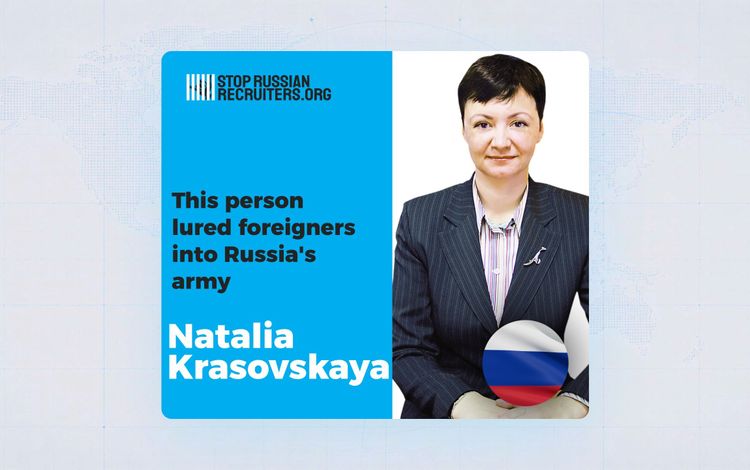
Natalia Rudolfovna Krasovskaya
- Born
- December 14, 1966
Full name in Russian: Наталия Рудольфовна Красовская (Гулина)
Maiden name: Gulina
Current role: Executive Director, Center for Public Diplomacy (CDP), coordinator of Russia's "Russian House" network across Africa
Legal status: Not sanctioned. Yet.
Who is Natalia Krasovskaya
Natalia Krasovskaya is the Russian state-linked coordinator of the "Russian House" network across Africa, which she has spent the past three years building out - officially billed as Russian-language and cultural-education centers but alleged by the Ivorian outlet Afrique Sur7, the Beninese site BeninCheck, and the anti-Wagner monitoring collective All Eyes on Wagner, in its investigation "From Dostoevsky to Drone Strikes: The Double Life of Russian Houses," to double as recruitment infrastructure funneling African students and young men into Russia's armed forces. No international sanctions against Krasovskaya herself have been documented yet, but the man who runs the organization she works under, Dmitriy Savelev, is under EU sanctions. Across the wider recruitment pipeline her network is accused of enabling, casualty figures collected by L'Intelligent d'Abidjan and other outlets run into the hundreds.
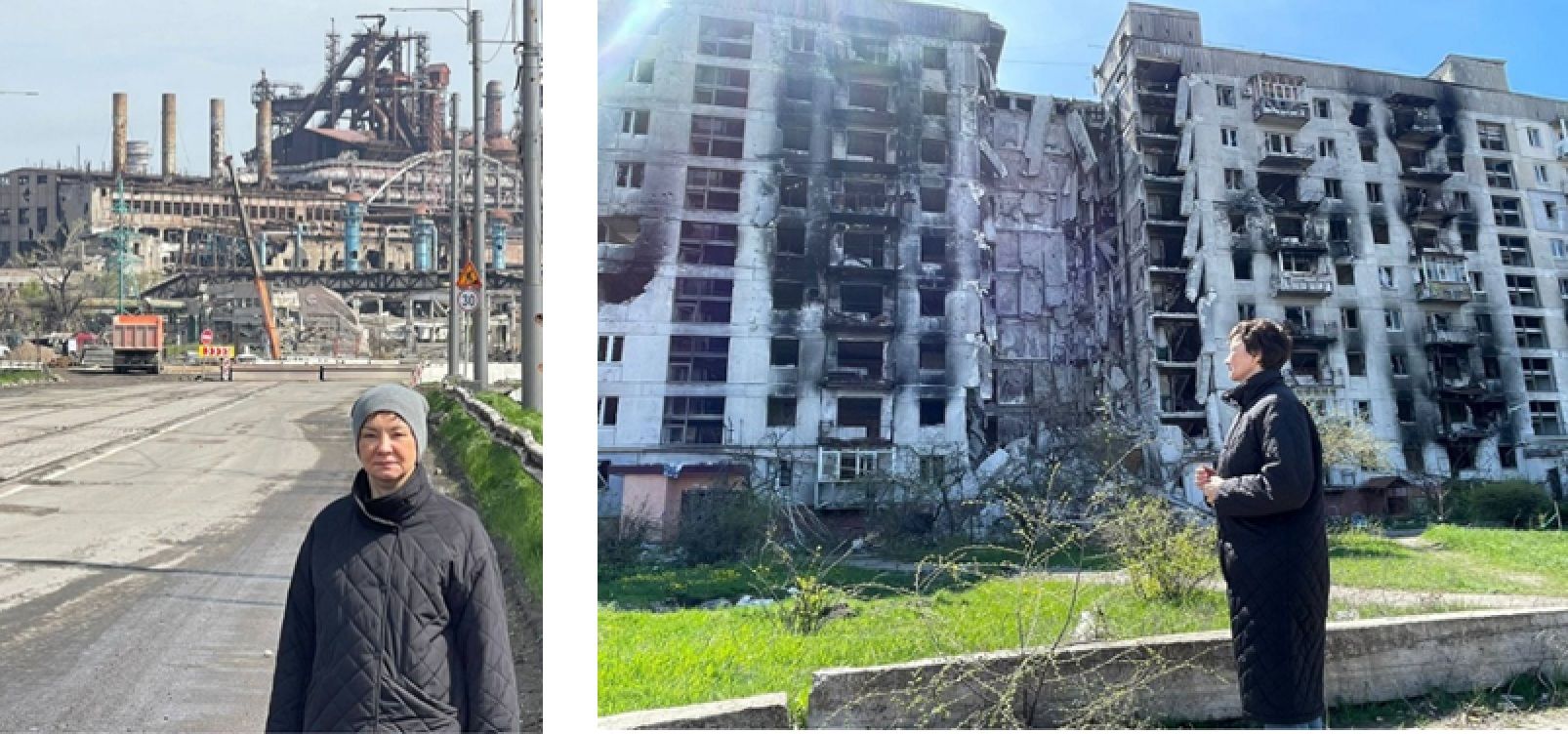
Krasovskaya worked as an information-warfare and psychology expert for Pravda.ru, a pro-Kremlin Russian news outlet, before entering Russian regional politics as a deputy in the Novosibirsk Oblast Duma and Vice President of its Legislative Council. She was initially elected under the banner of the LDPR, a nationalist party that has long positioned itself as opposition while generally backing Kremlin policy, where she argued that social media functioned as a weapon of propaganda. She joined United Russia, Vladimir Putin's ruling party, in 2024, following a wave of LDPR deputies into his presidential majority. Alongside her political career, Krasovskaya became an active supporter of Russia's war in Ukraine through the fund "Together Toward Victory," visited Russian-occupied territory - she was photographed in May 2023 in front of the destroyed Azovstal plant in Mariupol - and was awarded a medal for supporting the "special military operation." In February 2024, she was placed at the head of the Center for Public Diplomacy (CDP), a body registered in Russia's commercial registry on February 2, 2024, becoming its executive director. The CDP's general director, Dmitriy Ivanovich Savelev, is a State Duma deputy under EU sanctions. Krasovskaya worked as Savelev's political advisor before the CDP's creation, and the two have continued to collaborate closely - a report dated April 27, 2025, cited by both BeninCheck and Senego, describes them jointly working with the federal agency Rossotrudnichestvo to establish non-governmental "Russian Houses" in Africa, backed by both the State Duma's international-relations commission and Putin himself.
The Covert Recruitment Operation
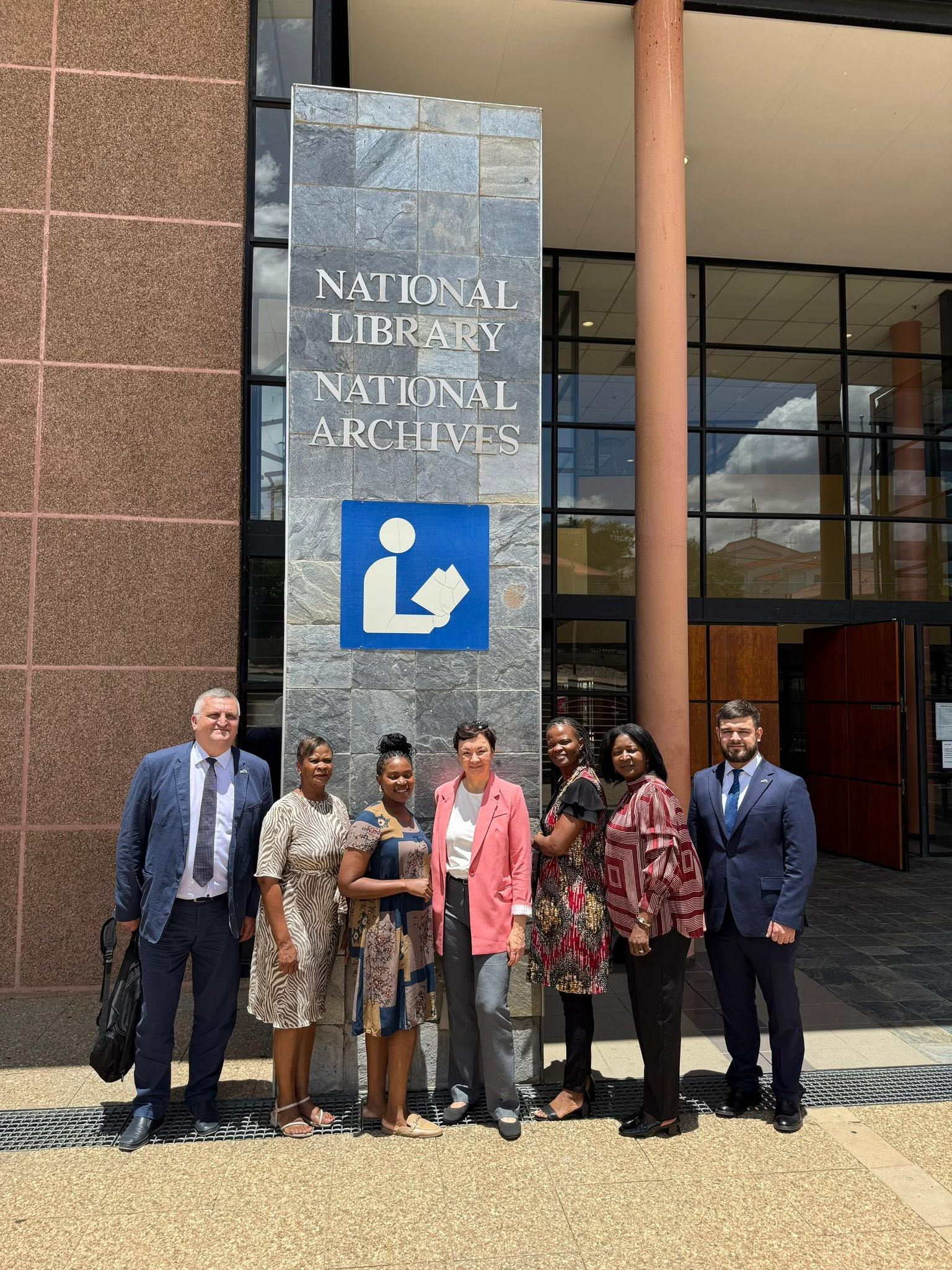
The first African "Russian House" opened in Burkina Faso in November 2023. Since then, Krasovskaya has personally driven the network's expansion, touring the continent - including Togo, Liberia, Sierra Leone, Ghana in March 2026, Namibia, and Niger - to hold talks, scout partners, and sign agreements with local universities: Kofi Annan University in Guinea, and the Anfoeta Technical Institute in Ghana's Volta region, where she launched a pilot engineering course. In February 2026, a joint education program was launched between the University of Namibia and the Siberian University of Engineering and Biotechnology, and the network signed a cooperation memorandum with the private evangelical Elim school in Niger. Krasovskaya documents her travels on a Telegram channel, presenting Russia as a "disinterested partner" whose only goal is supporting education and culture - messaging amplified by some Russian-influenced outlets, which African commentators say also helps logistically arrange the travel of African delegations to Russia, where military recruitment processes are then activated.
Yevgeny Primakov, the head of Rossotrudnichestvo, has himself publicly acknowledged that a "well-known African private military company" played a role in setting up Russian Houses in Mali and the Central African Republic. Lou Osborn of the All Eyes on Wagner collective told RFI in December 2025 that Russian Houses, including in Cameroon, "serve as relays for underground influence operations as well as industrial and military recruitment campaigns," working through local facilitators, travel agencies, and businessmen tied to a group of consultants called Africapolitologie that operated during Yevgeny Prigozhin's and Wagner's era running Russian operations on the continent. The recruitment pattern described by African outlets covering the network is consistent: a job or study offer, a visa issued without thorough vetting, and then, once in Russia, passport confiscation, forced military training, and deployment to the front.
The pattern shows up concretely in Ghana, where the Russian House in Accra is run by Polina Kvitnikh, a close Krasovskaya collaborator who previously helped expand the network through language programs in Niger. Since 2025, Kvitnikh has built academic partnerships, including with Novosibirsk State Technical University, that send Ghanaian students selected by competition to study engineering in Russia - officially framed as "spotting scientific talent." According to regional reporting, roughly 272 Ghanaians are now enlisted in Russia's army, of whom 55 have died in Ukraine. Neither Kvitnikh nor Krasovskaya has publicly responded to the allegations. Regional reporting also describes other Russian House directors in the same network whose backgrounds raise separate concerns - a Sierra Leone director with a prior career trading precious stones, and a Mali director serving on that country's transitional legislature while the local Russian House reportedly receives funding through Africa Politology, a group accused of pushing Russian-style "foreign agent" legislation in African parliaments - evidence, according to these outlets, that the network's ambitions extend beyond culture and language into political and economic influence as well.
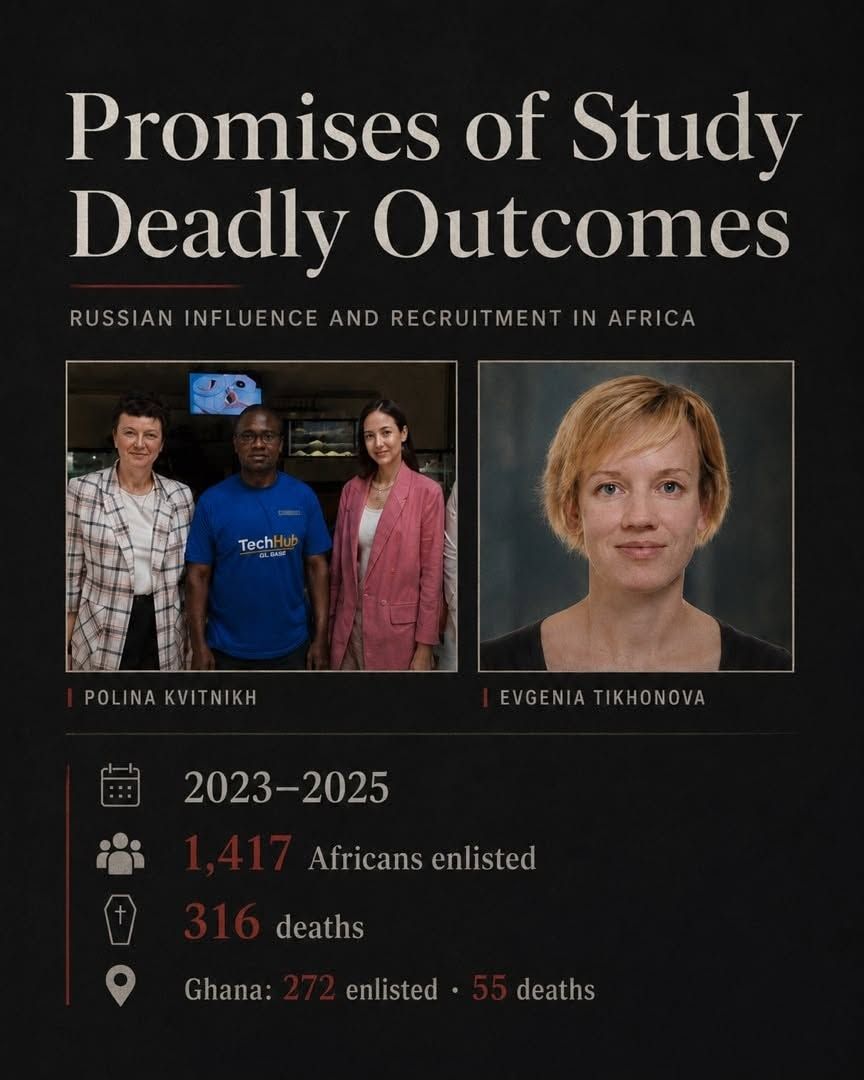
The wider recruitment pipeline that African outlets link to the Russian House network's "narrative of legitimacy" has produced significant documented casualties. The NGO collective All Eyes on Wagner puts the toll at more than 1,400 Africans from 35 countries who signed contracts with Russia's military between January 2023 and September 2025, with more than 300 killed; other regional outlets, citing the same period, report 1,417 recruits and 316 deaths. Cameroon has been named repeatedly: Russia has acknowledged the deaths of 16 Cameroonian nationals, and roughly 335 Cameroonians are reported to be serving in Russia's army, most of them young men, many of them students. In February 2026, Russia denied reports that it was recruiting Kenyans into its military, while still acknowledging that foreign nationals fight in its ranks - describing them only as "volunteers."