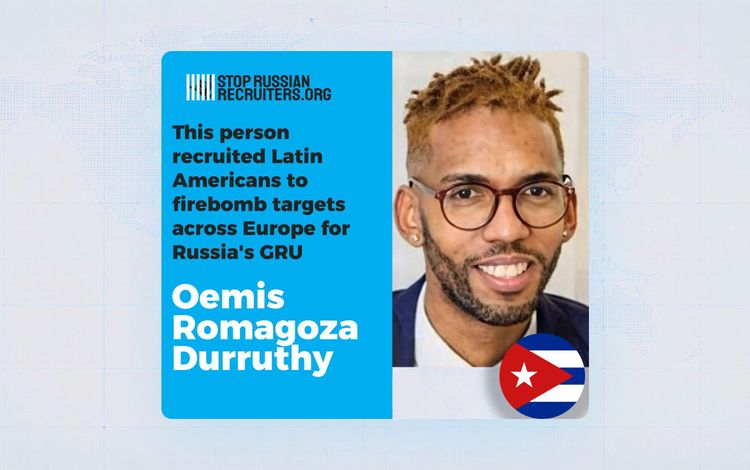
Oemis Romagoza Durruthy
Full name: Oemis Romagoza Durruthy
Year of birth: 1991
Legal status: Sought under an international arrest warrant issued by Lithuania
Summary
Oemis Romagoza Durruthy, a Cuban national who teaches salsa and bachata at a dance studio in the Russian city of Petrozavodsk, used the aliases "Adrian" and "Dios" - Spanish for "God" - to recruit at least a dozen people across Europe and Latin America into carrying out arson attacks on behalf of Russian military intelligence, according to an investigation published in September 2026 by DW. Lithuanian prosecutors have publicly attributed the sabotage campaign to Russia's GRU. In January 2026, they referred a criminal case to court charging six co-conspirators with terrorism-related offenses over the Lithuania attack alone, while continuing to seek Romagoza and two other alleged organizers under international arrest warrants. He has not been arrested and, per DW, did not respond to a request for comment. Most of the people he recruited - hired online, often without knowing who they really worked for - have since been arrested or convicted; Romagoza himself remains free, likely still in Russia.

Background
Romagoza was born in Camagüey, Cuba's third-largest city, and has lived in Russia for at least seven years. He teaches salsa, bachata, and kizomba at the Made in Cuba dance studio in Petrozavodsk, where he is listed alongside his wife as one of the studio's main contacts and regularly posts videos of his classes and performances on social media. He married a Russian woman in 2022 and later obtained Russian citizenship. Leaked financial records reviewed by DW show he ran into money trouble by 2023, borrowing from several credit lenders and, in one filing, listing a supermarket chain as his employer. In March 2024, he joined several Facebook groups for Latin Americans seeking work in Europe or looking to enlist in Ukraine's foreign battalions; DW also found Telegram accounts linked to him posting job ads around the same time. DW was unable to determine when or how he came to work for Russia's intelligence services.

How He Operated
Under the aliases "Adrian" and "Dios," Romagoza advertised in Telegram channels and Facebook groups aimed at Spanish speakers and Cuban expatriates in Russia - one ad, in Russian, offered "work as a photographer" in Poland; another, aimed at Latinos, sought "people with military experience in monitoring, intelligence, logistics and tactical maneuvers" for $1,500 (about €1,300) plus a bonus per completed operation. He also reached out directly to people posting in Facebook groups for Latin Americans hoping to join Ukraine's foreign legion, telling at least two of them not to go to Ukraine and offering paid "special missions" in Europe instead. He arranged everything for his recruits remotely - flight tickets, hotels, taxis - and never met any of them in person. Their first assignments were low-risk: photographing a building, filming a site. Researchers describe this as a standard opening move in recruiting so-called "disposable agents" - people who complete a seemingly innocent task, are then told they've committed a crime by working for a foreign intelligence service, and are pressured into continuing under threat of exposure to the police. Once a recruit had finished reconnaissance, Romagoza escalated to arson, sending satellite images marking targets and, in at least one case, instructing a recruit to buy materials to start a fire.
Over roughly four months in 2024, DW confirmed Romagoza directed recruits to set fire to two construction-supply businesses in Poland, a bus garage in the Czech Republic, and a recycling facility in Romania, and to carry out reconnaissance against the campaign's most significant target: TVC Solutions, a Lithuanian company that was manufacturing trailers holding radio-signal-detection equipment for the Ukrainian military at the time. DW reports at least a dozen people carried out or attempted to carry out missions for Romagoza; at least nine have since been caught, two are serving prison sentences for attempted sabotage or terrorism, and others remain under prosecution.
His Victims
Several of the people Romagoza recruited have been named in court documents and DW's reporting.
Luis Alfonso Murillo Diosa, a 34-year-old former Colombian army soldier from the coffee-farming town of Caicedo, was trying to enlist in Ukraine's foreign legion when Romagoza contacted him through a Facebook group, introduced himself as part of a "special group," and offered paid missions in Europe instead. Romagoza arranged his travel to Bucharest in July 2024 and sent him a satellite image marking a recycling facility and a nearby oil well to photograph. Murillo was arrested walking near the recycling facility at night; he told investigators he never intended to commit arson and hadn't known who he was really working for. In 2025 he was sentenced in Romania to six years in prison for attempted sabotage.
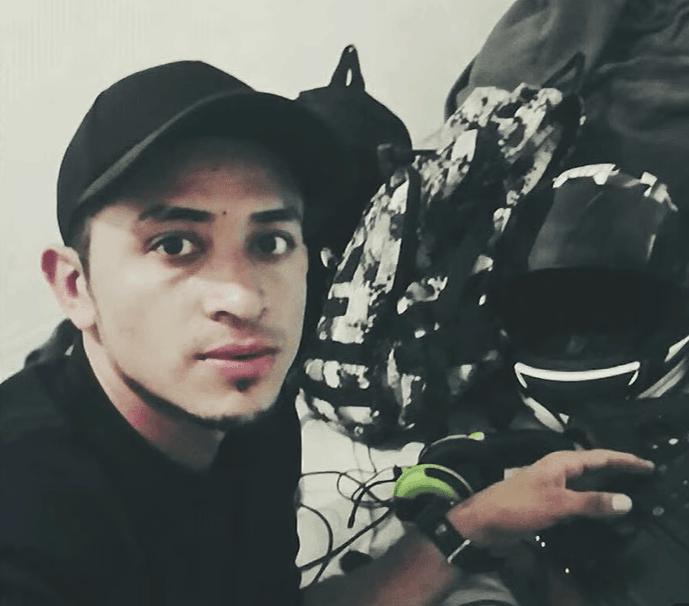
Andrés Alfonso de la Hoz de la Cruz, a 26-year-old Colombian army veteran, was recruited by Romagoza to set fire to construction-supply businesses in Poland - one blaze was later, falsely, blamed on Ukrainian nationalists by a pro-Russian Telegram channel. He was arrested in the Czech Republic days later after starting another fire in Prague, and was sentenced in Czechia to eight years in prison for terrorism. Poland has separately pressed charges against him and he is still awaiting trial there. At his sentencing he said he was "very sorry" and described feeling guilty for the shame brought on his family and for the time lost with his two children.

Gonzalo R., a 20-year-old dual Colombian-Russian citizen, had returned to Russia to help care for his sick mother and younger siblings when Romagoza recruited him to photograph TVC Solutions in Lithuania. His mother told DW she believes he had no idea what he was actually being asked to do. He left Lithuania after the reconnaissance mission but was arrested months later in Colombia and extradited to Lithuania in June 2026, where he is currently standing trial.
Mayra Eukaris De La Lastra Nistal (called "Mayra L." in DW's reporting), a dual Cuban-Spanish citizen born in 1965 and living in Russia, crossed into Lithuania on her Spanish passport to carry out a second round of reconnaissance at TVC Solutions before returning to Russia. She was arrested in Panama in July 2026 while trying to travel back to Cuba, and Lithuania has since issued an international arrest warrant for her as one of the case's alleged organizers.
DW also reports that two Spanish men recruited by Romagoza - one of them a dual Spanish-Colombian citizen, according to Lithuanian prosecutors - attempted to firebomb TVC Solutions with a homemade mixture of gasoline and motor oil in September 2024, but fled after spotting a police car nearby and were arrested weeks later in Latvia, where they'd fled, and extradited to Lithuania. A young Belarusian and a young Russian he later sent set a fire at the same company that, prosecutors said, "did not pose a serious threat" to the equipment; a Cuban national then traveled from Russia to Lithuania to relay a damage assessment back to the plot's organizers. In January 2026, Lithuanian prosecutors charged all six of these operatives - the two Spanish citizens, the Russian, the Belarusian, and two more described only as Cuban and Colombian nationals - with participating in a terrorist group, attempting a terrorist act, and financing terrorism, and referred the case to Šiauliai Regional Court.
Terrorism Charges and International Wanted List
On January 16, 2026, Lithuania's General Prosecutor's Office referred the Šiauliai case to court, according to Lithuanian public broadcaster LRT. Six defendants - one Spanish citizen, one dual Spanish-Colombian citizen, and citizens of Colombia, Cuba, Russia, and Belarus - are charged with participating in a terrorist group, attempting to commit a terrorist act, and financing terrorist activity; the most serious charge carries a prison sentence of five to fifteen years under Lithuanian law. LRT reported the indictment runs 258 pages across 42 volumes of case materials. Investigations into four more suspects continue: one was arrested in Colombia under an international warrant and is undergoing extradition to Lithuania, while international warrants have also been issued for Romagoza, for a Cuban national named Alexeis Pecora (born 1991), and for Mayra Eukaris De La Lastra Nistal.
Lithuanian prosecutors said the plot was coordinated from Russia by Cuban and Colombian nationals linked to the GRU. "Data from Lithuania's preliminary investigation provide reasonable grounds to suspect that the attempted sabotage in Šiauliai was carried out on the orders of and for the benefit of Russia's GRU," the prosecutor's office said, per LRT. Saulius Briginas, deputy head of Lithuania's Criminal Police Bureau, said the plot's alleged masterminds are beyond Lithuania's jurisdiction but have been identified and placed on international wanted lists, which he said has "effectively eliminated" them "from further criminal activity." Prosecutors also said Russian state-aligned Telegram channels tried to spin the failed attack into a propaganda win - falsely claiming a major fire had destroyed the equipment and blaming the incident on Ukrainian partisans or local antifascists - in what chief prosecutor Artūras Urbelis described as an attempt to seed dissatisfaction in Lithuania with continued military aid to Ukraine.
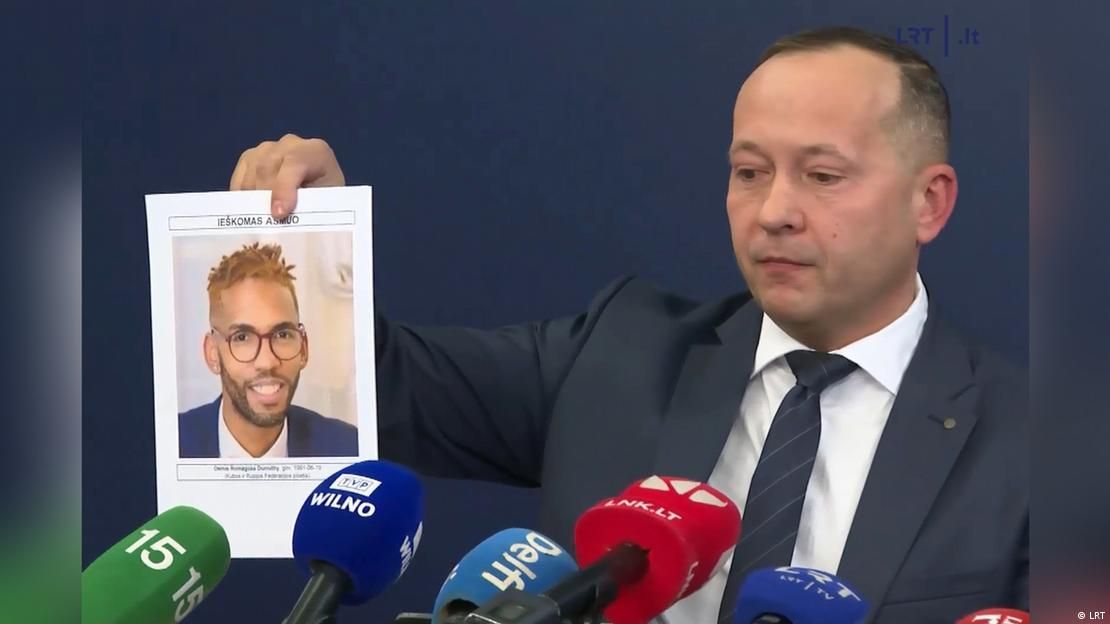
Romagoza himself has not been arrested, and DW reports he may still be in Russia. As of April 2026, the Made in Cuba studio was still posting videos of him teaching salsa classes in Petrozavodsk, and he joined at least two more Facebook groups for Latin Americans seeking work in Poland around the same time. Oemis Romagoza Durruthy did not reply to DW's request for comment.