July 1, 2026
Sent to Walk Into Minefields: A Dhaka Agency Trafficked 30 Bangladeshis Into Russia's Army
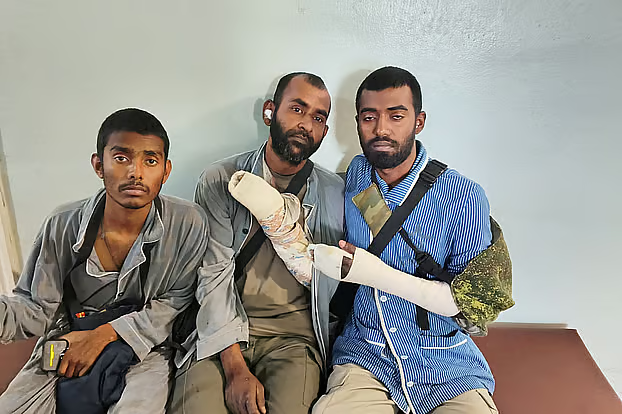
On the photo: Ali Hasan Sohel and other Bangladeshi nationals coerced to military service in Russia
Ali Hasan Sohel, 42, from Goalanda, Rajbari, drove an auto-rickshaw to support his family. A broker from his own area told him about a construction job in Russia. The agency, based in Dhaka's Malibagh, charged him Tk 700,000 (~$6,400). He left Bangladesh on 7 May 2026 with official BMET clearance - paperwork that made the whole arrangement look legal.
Within weeks he was in military uniform. Russian commanders put him and the other Bangladeshis in his group at the front of patrol formations - walking ahead of Russian soldiers to set off mines and draw drone fire before the regular troops advanced.
On 13 June, Sohel lost the hearing in one ear and had his hand badly injured. He was transferred to a military medical camp. From there, he called his wife. She saw him on a video call: hand bandaged, cotton packed into his ear, calling from inside a tent. He was alive. He told her that of the 30 men who had left Bangladesh with him, 12 were unaccounted for. He believes they are dead.
The story was reported by Prothom Alo on 29 June 2026.
The Agency and the Deception
The recruitment was handled by Jabel-e-Noor International Limited, registered in Malibagh, Dhaka. The men were promised construction and company jobs in Russia. The salary was stated as 60,000 rubles per month (~$680).
The broker who first approached Sohel was Imran Hossain, from Satoir in Faridpur's Boalmari upazila. He connected Sohel to the agency and took a share of the fees. The initial price quoted was Tk 800,000 (~$7,300) per person. After negotiation, Sohel and others in his group - including Palash Sheikh from Gopalganj's Uttarpara Ghosherchar, Rony and Sourav Molla, also from Gopalganj - each paid Tk 700,000 (~$6,400). Across the four individuals named in a complaint to Bangladeshi authorities, the agency collected at least Tk 28,00,000 (~$25,500) in fees. According to Prothom Alo, the men were then "sold" to the Russian military for Tk 3,075,000 (~$28,000) each - more than four times what the men themselves had paid. The agency had not recruited construction workers. It had recruited fighters.
The men departed Bangladesh on 7 May 2026 with clearance from the Bureau of Manpower, Employment and Training (BMET) - the Bangladeshi government body responsible for authorising overseas work. Their departure was documented, approved, and entirely above board on paper. The destination was not.
What Happened in Russia
A female representative from the agency met the group at Moscow airport. They were kept in a hotel for three days. Then they were handed to Russian military officers. Their heads were shaved. They were dressed in military uniforms. They were given weapons and several days of basic training - barely enough to learn how to handle a rifle. Then they were deployed to occupied areas of Ukraine.
The group of 30 was split into two teams - one of 16, one of 14. They were sent in different directions across four occupied regions. Their role, as described by Sohel, was to walk ahead of Russian soldiers. If there was a mine, they would trigger it. If there was a drone, they would draw it. The Russian soldiers stayed back and watched from a distance. The Bangladeshis went first. Another injured Bangladeshi - Rajon, from Jhenaidah - had arrived at the same medical camp three days before Sohel called home. Palash Sheikh, who had left Bangladesh in the same group and paid the same fees, was also there, also wounded.
Complaint Filed, No Response
On 19 May 2026 - less than two weeks after the men had left - a complaint was filed with Bangladesh's Ministry of Expatriates' Welfare. By the time Prothom Alo published its investigation in late June, no meaningful official response had been received. Sathi Das, the chief administrative officer of Goalanda upazila, told Prothom Alo she was unaware of the case and would act if the family filed a formal legal complaint. Sohel's family is not waiting in silence. His wife saw him on a screen, from a tent, bandaged and half-deaf, surrounded by war. She knows where he is. She does not know how to bring him home.
The Same Playbook
The Jabel-e-Noor agency case follows the same documented recruitment model seen across Asia, Africa, and Latin America. A local broker introduces candidates. A registered agency handles paperwork and takes the fee. BMET clearance is obtained. The men depart legally. On arrival, phones may be taken. Civilian clothes are exchanged for uniforms. Whatever was promised - construction, logistics, security - disappears. What sets the Bangladesh cases apart is the specific role Russian commanders have assigned to these recruits: not support roles, not rear positions, but the most exposed position on the battlefield. Walking ahead. Finding the mines the hard way.
For Bangladeshi Families
If you or your relative signed or were coerced into signing a contract with the Russian Armed Forces and are looking for a way out - Ukraine offers a safe way out. Read more here.
Source: Prothom Alo