August 19, 2026
EUvsDisinfo Investigated Russia's Global Foreign Recruitment Pipeline. Here Is What They Found.

A European External Action Service (EEAS) investigation has traced Russia's global foreign recruitment infrastructure to a small cluster of organisations operating behind dozens of websites, hundreds of ads, and fake staffing agencies across four continents. The findings are published and analysed by EUvsDisinfo.
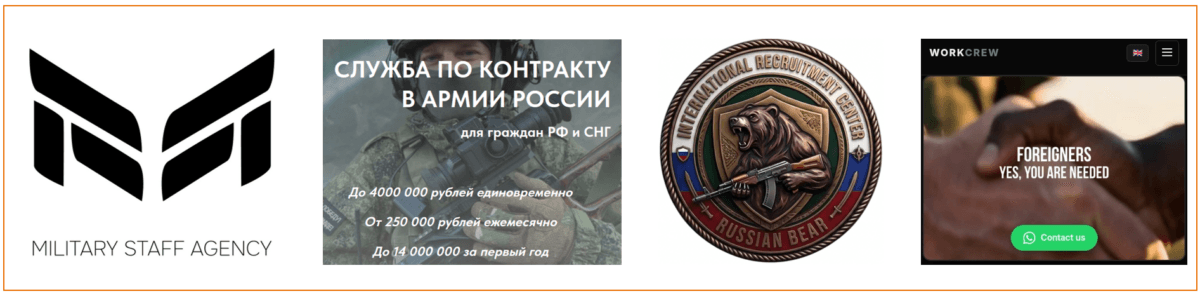
The investigation found four recruitment brands: Military Staff Agency, Work in Russia, IRC Russian Bear, and Work Crew Agency. The first three share WhatsApp contact details that link them to a single Russia-registered organisation called "Central Headquarters" - co-located with a volunteer battalion training centre in Bashkortostan, Russia. A domain associated with Work Crew Agency was separately linked to Roman Saponkov, a Russian military blogger already under Ukrainian sanctions for backing the invasion, with documented ties to the Wagner Group.
See also: Roman Saponkov profile on "War and Sanctions" portal
The pipeline these brands serve is what has sent over 28,000 foreigners from 135 countries into Russia's armed forces by late 2025.
The Digital Infrastructure
Investigators found recruitment ads running on Meta, WhatsApp, and at least 35 websites operating in up to 40 languages - Indonesian, Thai, Malay, Arabic, Wolof, French, and Spanish among them. Dedicated domains were registered for Brazil, Serbia, and the Democratic Republic of Congo. In total, 85 paid ads focused on Russian military staffing were flagged to Meta. Seventy-eight are no longer accessible.
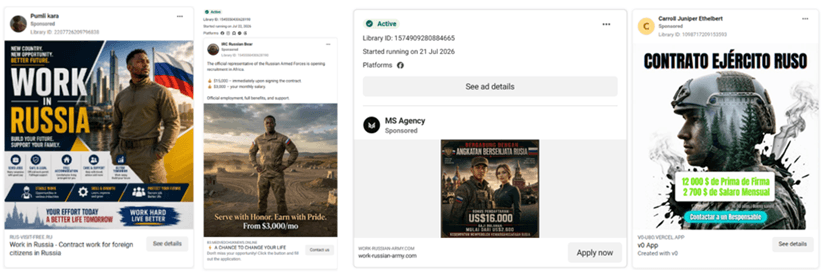
The network used four tactics to avoid detection. First: AI-generated recruitment posters designed to look like generic job postings, with the military nature only disclosed once clicked through. Second: French and Spanish language ads funnelling users to polished third-party landing pages built on app-builder platforms to harvest contact details. Third: disposable, freshly-registered domains used as redirects to the actual recruitment sites - a technique borrowed from the Kremlin's Doppelganger disinformation campaigns. Fourth: fake but professionally designed Facebook pages posing as legitimate staffing agencies.
The Geographic Pivot
The campaign's targeting sequence tells its own story. African audiences were the first to be hit - in June 2026. By July the focus had shifted to Latin American users, including diaspora communities in Italy, Spain, Poland, Romania, and Bulgaria. By the end of that month the net had expanded into Southeast Asia.
This sequence tracks with the pattern of diplomatic pushback. As India secured repatriation agreements and Nepal banned its citizens from travelling to Russia, the recruitment machine moved to less resistant markets. An INPACT investigation had already documented at least 1,417 African citizens signing Russian military contracts between January 2023 and September 2025 - almost certainly an undercount, given that Kenya's National Intelligence Service alone has identified over 1,000 Kenyan nationals recruited. In Latin America, Ukrainian military intelligence estimates 10,000 to 15,000 Cubans are fighting in Russia's ranks, with over 1,000 identified by name. Families of hundreds of deceived Peruvians have protested outside Peru's Ministry of Foreign Affairs and the Russian Embassy in Lima.
How the Pipeline Works
Once contact is made via an ad or website, intermediaries - influencers, middlemen, travel agencies, or purpose-built companies - handle logistics, often charging fees offset against the promised salary of up to $3,000. On arrival in Russia, passports are taken. Recruits are coerced into signing military contracts in Russian - a language most do not understand. A brief training period of up to two weeks follows, often at the Avangard Academy near Moscow. Then deployment to Ukraine.
The case of a Nepali man named Nandaram Pun, documented by The Guardian, illustrates how completely the pitch can diverge from reality: he was promised a job in Germany, told to travel via Russia, and ended up fighting in Bakhmut.
Russia's Admission by Omission
In February 2026, facing growing backlash from governments across the Global South, the Kremlin announced a ban on recruiting citizens from 43 "friendly" countries, including China, India, Brazil, Turkey, Cuba, Iran, and Venezuela. The ban is an implicit acknowledgement of the scale of the operation - and of the political cost it was extracting from relationships Moscow had invested heavily in cultivating.
The International Federation of Human Rights has concluded that Russia bears legal responsibility for violations in this field, and that third states may be liable for failing to prevent trafficking, prosecute perpetrators, and repatriate victims.
Russia has presented itself to the Global South as a partner in resisting Western dominance. The EEAS investigation documents what that partnership has looked like in practice: a coordinated digital machine, run from a battalion training centre in Bashkortostan, targeting economically vulnerable people across Africa, Latin America, and Southeast Asia with fake job ads in 40 languages.
People who were lured into Russia's army have a chance to safely escape the battlefield. Read more details here.
Source: EU vs Disinfo